
Biography
Faouzi Messeoud is a Tunisian thinker and researcher. Born on August 28, 1969, in the “Alim” area of Gafsa Governorate in southwestern Tunisia, he works as a software engineer.
He heads "F.M.Soft" FMSoft, specialized in software, through which he developed the "Tasarruf" family of IT solutions (Tasarruf Commercial, Tasarruf Payroll).
During his secondary education, he became involved in the organization of the Islamist movement, and continued this activity through his early university years, before becoming politically independent.
Faouzi Messeoud combines in his project the rigor of mathematical modeling, drawing on his training as a software engineer, with philosophical and civilizational analysis. This interaction between the technical and intellectual dimensions contributed to the development of the “Intellectual Modeling Methodology,” which aims to analyze the models and centralities that frame reality, reveal the mechanisms through which they are formed and their effects, with particular attention to the Western model and the historical and intellectual relationship with France. One aspect of this project was examined in a master’s thesis at the University of Carthage in 2025.
In 2003, he founded the website "MyPortail" (بوابتي) and oversees its editing; the site later grew into a platform where dozens of Arab authors write, hosting thousands of articles and intellectual studies.
فوزي مسعود (Faouzi Masseoud) works on an intellectual project aimed at breaking away from Western models and their centrality, with particular focus on the relationship with France. In this field, he has published two books: "The Immaterial Link of Tunisians with France" and "Doctrinal Centrality and the Conceptual Field." He has also written more than a thousand articles and has other book projects underway.
In addition, he regularly publishes articles and intellectual content via his Facebook page and MyPortail, and offers interviews and dialogues broadcast on his YouTube channel.
On April 30, 2025, a master's thesis at the University of Carthage – Higher Institute of Languages of Tunis was devoted to the study and analysis of his book "The Immaterial Link of Tunisians with France," through the translation of its first chapter and a discussion of the terms it introduces.
Faouzi MESSEOUD — Consultant in Thought and Strategy
Alongside his intellectual and research activity, Faouzi MESSEOUD offers intellectual and strategic consultations on issues related to the analysis of systems of thought, as well as the construction of positions, visions, and strategies.
Discover the consulting spaceAcademic Background of Faouzi MESSEOUD
Second university cycle (1996 – 1998): he joined the Higher School of Engineers of Tunis (*), where he studied for three years in the field of Computer Science / Informatics, and obtained in July 1998 the National Diploma of Engineer in Informatics. Faouzi MESSEOUD is registered with the Order of Tunisian Engineers under number: 23091.
First university cycle (1991 – 1993): he studied for three years at the Higher Institute of Technology of Nabeul (ISTN, which later became ISET Nabeul) in the field of Electromechanics, graduating with a University Diploma of Technology (DUT) in the same field. Thanks to his academic excellence, he was directed toward the National School of Engineers of Tunis (ENIT), but did not enroll there for personal reasons, and paused his studies for three years.
(*) This institution was later renamed: the Private Higher School of Engineering and Technological Studies of Tunis.
Intellectual Project and References
The intellectual project of Faouzi MESSEOUD has developed through a number of works and concepts leading to the Intellectual Modeling Methodology. The methodology pages, the Intellectual Modeling Laboratory, works, and comparisons can be consulted through MyPortail.
Published Works
Books and articles
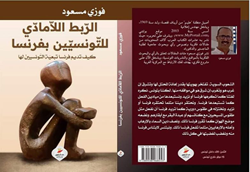
Book: The Immaterial Link of Tunisians with France
Year: 2023 Publisher: Dar El Alaoui
Genre: Non-fiction
An in-depth analytical and critical work addressing a sensitive issue in the relationship between Tunisia and France, showing that the real link is not merely material (economy, trade, community) but is fundamentally an immaterial link that shapes collective consciousness and reproduces dependency in indirect forms. The author focuses on the elements of this immaterial link, such as the French language, the education system, the media, political discourse, and the notion of "historical relations" used to keep Tunisians in a state of permanent psychological and cultural attachment to France. The book puts forward a bold thesis: that France represents the greatest threat to Tunisian sovereignty, even greater than "Israel," because it inhabits the mental structure of society and influences patterns of thought, language, and political imagination. The author explains this influence through what he calls the intellectual architecture and the thinking actors — that is, the forces that shape consciousness and steer it toward accepting dependency as something natural. The book is distinguished by its methodological dimension, as it does not merely diagnose the problem but seeks to deconstruct the mechanisms that sustain this link, calling for the construction of a new sovereign consciousness based on liberation from mental and cultural dependency before any economic or political liberation. It also issues an explicit call for an epistemic break with the French frame of reference and the restoration of the authentic civilizational reference that grants Tunisians true independence.
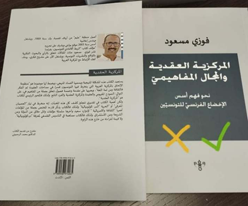
Book: Doctrinal Centrality and the Conceptual Field
Year: 2023 Publisher: Dar Wachma
Genre: Non-fiction
A critical intellectual work that seeks to deconstruct the roots of the intellectual and cultural dependency afflicting the Arab and Islamic reality. The book proceeds from the premise that every human society moves within a horizon of doctrinal centrality that frames its actions and values and determines their soundness or corruption. It shows that the absence of awareness of this centrality has led to a deep methodological corruption, forcing Muslims — and Tunisians in particular — to become caught up in Western centrality, which has imposed on them its systems of education, media, culture, and language. In his introduction and five chapters, the author addresses concepts such as: the conceptual model, doctrine, doctrinal centrality, the conceptual field, and the dependent individual, to affirm that dependency is not merely economic or political, but is above all a doctrinal and intellectual dependency. The book is part of a knowledge project aimed at restoring Islamic centrality and freeing the Arab conceptual field from Western hegemony. The style is distinguished by combining analytical precision with a literary dimension, presenting ideas in a sequential manner close to scattered pearls, offering the reader both an intellectual and an aesthetic experience. The book represents a contribution to the current of "epistemic disobedience" aimed at deconstructing colonial hegemony and laying the foundations of free and independent knowledge.
Articles and Research
Various: 2005-2025
Outlets: Babnet, Ezzarra, MyPortail, ...
Over the course of his intellectual career, the author has produced hundreds of articles and thousands of pages of theoretical and intellectual writing, all branching out from interconnected central themes that together form a cohesive project. He has dealt in depth with the problem of the dependent individual who lives under a dominant intellectual centrality and thereby loses his independence, and has extensively critiqued the phenomenon of the dependent thinker who perpetuates — consciously or unconsciously — intellectual and cultural dependency on the West. He has also given special attention to the question of doctrinal Islam as the supreme frame of reference and the system that grants society its cohesion and direction. Alongside this, he has addressed issues of formal religiosity, which conceals the essence of knowledge and replaces it with mere superficial ornamentation, and has sought to deconstruct the French system in terms of the immaterial link and cultural and political hegemony it exerts over Tunisian and Arab consciousness. His writings have also not overlooked miscellaneous issues connected to social, intellectual, and political reality, making his project highly diverse while remaining methodologically and conceptually coherent.
تقدير واعتراف ثقافي
The book "The Immaterial Link" was selected as one of the best recommended books for reading at the Tunis International Book Fair (40th edition) by the intellectual website "Tibyan," in recognition of the depth of the methodological thesis in deconstructing dependency.
Intellectual Works
The Intellectual Journey
Recent Publications
This was a period of intense intellectual activity, during which he published two books and began engaging with media and intellectual platforms such as Al-Ruwad, Al-Hadhara, Al-Balagh, Ansaq, Mizan, as well as Zitouna TV.
Period of Maturity
During this period, I was arrested and imprisoned for two weeks under the anti-terrorism law, because of articles I had written, some of which addressed the rejection of French hegemony in Tunisia through the imposition of French educational curricula in private schools. Political developments in the country, and the lost opportunity of the "revolution," also contributed to the maturing of many of the ideas that would later crystallize in my writings.
The Early Years of Media Activity and Intellectual Formation
In 2003, I founded the MyPortail website and expanded it into a platform attracting dozens of Arab writers. At the time, I was writing opinion articles while overseeing the editing of the site, until it was shut down in 2009 by the Ben Ali regime, following the publication of an article by one of the Tunisian writers residing abroad about the corruption of Leila Ben Ali, the president's wife.
Activist Commitment
The years of secondary and university education were marked by my involvement in the organizational cells of the Islamist movement, alongside deep doctrinal formation and intensive intellectual reading, followed by a break from partisan organization and then a period of reflection.
Contact
For inquiries about publishing on MyPortail, or regarding فوزي مسعود (Faouzi Masseoud) about his lectures, collaboration, or purchasing his books
Send a Message
Social Media
Follow to keep up with the latest posts, articles, and interactions with them
Video Interviews
Follow to watch interviews and dialogues with media platforms
Books
My books are available from their publishers: "Dar El Alaoui" and "Dar Wachma," and can also be purchased by contacting me directly for later delivery.